Highlighter Yellow: What My Father-in-law’s Bible taught me about how to read God’s Word.

I have learned more about loss this week than in any other time in my life. Last week while enjoying NBC’s Thursday night line-up my wife got the call that her Dad, Ron Hines, suddenly passed away. So we did what anyone else would do and rushed home. Unfortunately for us, that included a 10-hour drive from North Carolina to Illinois. Naturally, there were many tears and much pain.

The highlight of this awful week was my wife’s speech at her Dad’s funeral. She dedicated a large section of the speech to findings in his Bible. Ron Hines devoured his Bible. Bright yellow highlighter covered every book, notes thoughtfully written to the side of prominent passages, and many papers of sermon notes. My wife was blessed as she read his notes from this tattered book. Ron read his Bible often, marked it thoroughly, and prayed over what he read.

There is debate on how Christians should treat their bibles. A dear friend of mine (and one of the most godly guys I’ve ever known) from College never wrote in his. He was worried that highlighting too much would defeat the purpose all together. He also thought writing notes would be further self-defeating, “What if you change your mind?” He reasoned. Having a degree in Biblical Studies I have thought about these issues often. How a believer interacts with Scripture is important. Contrary to what some may say, the Bible is unique. However, I must say that seeing my sweet wife look over her fathers marked up Bible gave me a different perspective.

Mark it up. Highlight, underline, and make notes. I am convinced that this not only cultivates a more thoughtful reading of God’s Word, but more than that I am convinced that it is a message to a future generation: The Bible is not meant to merely be read, it is to be devoured. It is the very air a Christian is to breathe. That is what Ron Hines’ Bible says of God’s Word.

I am sure that there will be many who will disagree. You just can’t make yourself take a pen to such a Holy Bible. I hear ya, but let me tell you -My wife wouldn’t trade Ron Hines’ NIV Men’s Devotional Bible for all the money you had to offer. It will testify to her for years that God is good, His Word is true, and that our lives are to be lived for His glory.

Ron was far from a perfect man. He was a sinner. Sometimes obviously so. Thankfully Ron was aware of his sinful nature and found life in a book he marked with yellow highlighter. I can only hope my future children will be lead to love the Bible more by my life and like Ron- my death.

Seminary and Scared: Why I am terrified to be at SEBTS and how you can pray for me.

I am absolutely terrified.

Tomorrow marks my first day as a seminary student at the Southeastern Baptist Theological Seminary in Wake Forest, N.C. I am thrilled of course, but I would be lying if I didn’t say I was scared. I am scared because I am about to get exactly what I asked for and it makes me very uncomfortable. Let me explain.

I have always been an introvert. Hand me a cup of coffee, a good book, and I will retreat for hours away from any living human being. This is not exactly a problem, but if not watched carefully can become one. This is especially the case for those who have a desire for gospel ministry. This is not hard to understand. Ministry is first and foremost about God’s glory, but secondly ministry is about loving, interacting, and sharing life with people. This includes getting the gospel to our unbelieving neighbors.

After graduating Boyce College I became aware that I was lacking in persistent evangelism and disciple making. So after two years I applied to Southeastern. I chose to do so because they advertise the institution as a, “Great Commission Seminary” where every classroom is a “Great Commission Classroom.” Consider the seminary’s mission statement:

“Southeastern Baptist Theological Seminary seeks to glorify the Lord Jesus Christ by equipping students to serve the Church and fulfill the Great Commission.”

In fact, during the first address to incoming students SEBTS President Dr. Danny Akin had the following as one of his points,

9. “Put no limitations on how and where our King might use you. Ask the Lord to give you the ability to truly pray, “Lord, why should I stay?” (Being Faithful To the High Calling of Christ)

Have mercy what have I done.

At Southeastern there is no room for academia for academia’s sake. The Bible is not an end to itself, but a means to love and know Christ. Furthermore, there is no room for those who do not want to be on mission now as they prepare for ministry. These people walk what they talk. 

The introvert in me needs this place. I need brothers to push me to share the gospel, take initiative with my neighbors, and to be open to the possibility that God could send me anywhere. 

So please pray for me. Pray that I would be disciplined in every class. Pray that I would be faithful with my time not ever neglecting to serve my wife with joy. Pray that as I grow in theological knowledge my heart will grow in doxological praise.

Finally, pray that God gives me a burden for my neighbor. That a love would grow in me that can only be expressed in sharing the gospel for the glory of God.

I am terrified and that is a very good thing.

Beyond Racial Gridlock by George Yancey: A summary and some brief thoughts.

As we move deeper into August schools everywhere are preparing for the upcoming Fall semester. As usual this means faculty members at every level are attending workshops to kickoff the new year. Here in Wake Forest the Southeastern Baptist Theological Seminary is no different. During these workshops professors heard presentations from Dr. George Yancey, Professor of Sociology at the University of North Texas. The subject regarded Yancey’s Beyond Racial Gridlock (IVP, 2006). In this work Yancey evaluates four secular models that attempt racial reconciliation. He does so by sketching a brief history of the position, analyzing its strengths and weaknesses, and discussing how Christians have incorporated the model in their own attempts at racial reconciliation. Ultimately, he finds these models to be incomplete and offers a solution from his own Christian worldview. What  follows is a summary of Beyond Racial Gridlock. Justice cannot be done to the full weight of his arguments so readers are encouraged to check out the book. I am thankful for SEBTS and their desire to see diversity not only on the campus, but in the Church as well. 

Foundational for Yancey’s book is the idea that there are two types of racism. One view is individual racism. Yancey writes, “An individualist understanding defines racism as something overt that can be done only by one individual to another.” (pg. 20) The other; however, is structural. “According to this view, society can perpetuate racism even when individuals in the society do no intend to be racist.”(pg. 22) Of course, how one defines racism will dictate the solutions offered. Yancey points out that the first two models are based on a more individual definition and the final two are based on a structural point of view.

4 Secular Models

Colorblindness: This approach is somewhat self-explanatory considering its title. Colorblindness has has its desire to make race a nonissue in society. Yancey states it this way, “The core argument of the colorblindness model is simple: to end racism, we have to ignore racial reality.” (pg. 29) Yancey goes on to describe this position as seeking “not to take race into account” and having as their goal “to get beyond racial issues.” 

Anglo-Conformity:  This model desires to teach minorities the proper ways to succeed in life. This includes education, how to find and keep a job, etc. Yancey describes the goal of this approach as follows, “The majority must teach people of color how to succeed, while the minority is responsible for taking those lessons to heart so they can achieve economic and educational success.” (pg. 42) Fundamentally, this approach finds the problem to be socio-economic as opposed to being about race. “Anglo-conformity is a very materialistic model. At its core is the belief that the real source of racial strife is economic disparity between the racial majority and minorities.” (pg. 42)

Multiculturalism: Advocates of this approach long to preserve the cultures of all people and see them as helpful contributors to our world. Yancey equates multiculturism to cultural pluralism; however, he wants to be sure to define the terms properly. Cultural pluralism is not the same as “inegalitarian models of racial oppression (in which cultural separation was dictated to the minority by the majority).” (Pg. 53) Later Yancey states, “Multiculturalism is the practical application of cultural pluralism.” (pg. 53)

White Responsibility: This argument suggests that the problems of racism are primarily because of the “majority group.” Thus, it is the responsibilty of this majority group (whites) to end racism. First, the group must deal with the racism inside them before any progress can be made. Extreme proponents of this position even argue that minorities are completely incapable of being racist. (pg. 65) Yancey writes, “From their viewpoint, racial minorities can have prejudice, but they cannot be racist because racism requires structural power. Since only dominant group members have structural power in our society, only dominant group members practice racism.” (pg. 65)  

After discussing each model Yancey discusses why he believes these approaches fail. Consider this quote, 

“Each of the four secular models identifies one source of racial conflict and proposes solutions to deal with that source. Certainly each source is at last partially responsible for racial alienation. The strength of these models lies in their recognition of a particular cause of racial tension and in their effort to resolve it. Their weakness lies in their refusal to identify other sources of the problem. At best, these incomplete models can help us correct certain aspects of racial tension, but they will never eradicate the problem.” (pg. 79)

A Mutual Responsibility Approach 

With these incomplete models in mind Yancey establishes that the root of racism is sin. Everyone is a sinner-no one is excluded, except Christ. Communicating this with evangelical conviction Yancey writes, “Our sin nature drives majority group members to look for both overt and subtle ways to maintain the advantages of their racial status. Our sin nature motivates people of color to use their victim status to gain whatever they can.” (pg. 80) Yancey concludes that racial reconciliation is a mutual responsibility because of this universal sin nature. In chapters seven and eight Yancey discusses the sin of both European Americans and racial minorities. I would encourage readers to think about what Yancey writes; however, more reflection is needed on my part before I can discuss them here. 

After establishing that everyone is mutually responsible Yancey turns to Scripture. He mentions John 4 and discusses the woman at the well and Jesus’ call of Matthew the tax collector. Yancey then points to Jesus as the way and example of reconciliation.

The question thus becomes, what does mutual responsibility look like? It starts with each party being honest about their fears and open to discussing the needs and concerns of others. Using an illustration from his own marriage (pg. 129-131) Yancey shows that the willingness to listen to the concerns of others regarding racism is vital.  Mutual understanding can lead to a mutual responsibility of reconciliation.  Yancey then offers a starting place in regard to mutual responsibility:

Multiracial churches: “One of the best ways to to heal racial strife is to fellowship with Christians of different races.” (Pg. 144) 

Social Networks: “For racial perceptions to be influenced by interracial friendships, we must be involved in social networks that are thoroughly multiracial.” (pg. 146) Later Yancey writes, ” Diversifying our social networks is a Christian was to help heal strife in our society.” (pg. 146)

Political Activism: Here Yancey discuses the tension between Republicans and Democrats. He notes that because Christians are pro-life they generally vote for conservative candidates. Unfortunately, Republicans are less likely to support programs based on race. Yancey makes a good case that Christians should be careful about political activism, but should participate. (pg.147)

Christian Academic Institutions: “Christian colleges’ failure to promote racial reconciliation is particularly distressing because they are the source of our future Christian leaders.” (Pg. 149)

Fully aware that he cannot provide the perfect answer to racism this side of glory Yancey ends his book with a plea for Christians to contribute to a more complete solution. Ultimately, it must be the gospel that does away with racism, but this book provides helpful ways that Christians can contribute in the healing process. The weight falls not on “them” or on “us” but there is a mutual responsibility due to the nature of sin to seek reconciliation because of the gospel of Jesus Christ. What more could we ask of an author than that? 

Is Church Membership a Biblical Concept?

This morning I attended a meeting in St. Louis for church planters called Plant Midwest. They bring in a variety of different teachers to exhort those who are involved in church plants. The speaker for the day was Sam Storms, pastor of Bridgeway Church in Oklahoma City, Oklahoma. The topic was church membership. Storms is a great person to address such a topic, because when he was called to Bridgeway, the church was without any form of church membership.

Storms posed the following question, “Is church membership biblical?”

“Well, that depends on how one defines biblical!” He responded.

Storms went on to explain that there is no where in Scripture that states plainly something like, “Thou shall be a member of a church.” The question is, is such a statement even necessary to defend church membership? The answer is most certainly no.

Storms then offered eight truths found in Scripture that make little sense if not understood in a covenant membership context.

1. Accountability to the elders in the church

Obey your leaders and submit to them, for they are keeping watch over your souls, as those who will have to give an account. Hebrews 13:17

Let the elders who rule well be considered worthy of double honor, especially those who labor in preaching and teaching. 1 Tim 5:17

2. Requirements that shepherds pastor their flock

 Pay careful attention to yourselves and to all the flock, in which the Holy Spirit has made you overseers, to care for the church of God,[a] which he obtained with his own blood. Acts 20:28

Shepherd the flock of God that is among you, exercising oversight, not under compulsion, but willingly, as God would have you; not for shameful gain, but eagerly; not domineering over those in your charge, but being examples to the flock. 1 Peter 5:2-3 

3. Church discipline

If your brother sins against you, go and tell him his fault, between you and him alone. If he listens to you, you have gained your brother. But if he does not listen, take one or two others along with you, that every charge may be established by the evidence of two or three witnesses.  If he refuses to listen to them, tell it to the church. And if he refuses to listen even to the church, let him be to you as a Gentile and a tax collector. Matthew 18:15-17

When you are assembled in the name of the Lord Jesus and my spirit is present, with the power of our Lord Jesus. 1 Corinthians 5:4

For what have I to do with judging outsiders? Is it not those inside the church whom you are to judge? God judges those outside. “Purge the evil person from among you. 1 Corinthians 5:12-13 

4. List of widows enrolled

Let a widow be enrolled if she is not less than sixty years of age, having been the wife of one husband. 1 Timothy 5:9

5. Congregational decision making

Then it seemed good to the apostles and the elders, with the whole church, to choose men from among them and send them to Antioch with Paul and Barnabas. They sent Judas called Barsabbas, and Silas, leading men among the brothers. Acts 15:22

6. Responsibility in the household of faith

So then, as we have opportunity, let us do good to everyone, and especially to those who are of the household of faith. Galatians 6:10

7. The gathering of the church

If, therefore, the whole church comes together and all speak in tongues, and outsiders or unbelievers enter,will they not say that you are out of your minds? 1 Corinthians 14:23

8. The variety of biblical metaphors for the church: body, flock, building, etc.

When considering these biblical realities it seems obvious that the answer to, Is church membership a biblical concept, is yes. One is hard pressed to explain the previous scriptural commands and truths outside of the context of church membership. I am grateful that Sam Storms took the time to speak at Plant Midwest. However, I do want to say that what has been written was derived from my own personal note taking. Therefore, all errors should be attributed to me and not Dr. Storms.  However, I do believe I represented his point faithfully.

You can purchase Dr. Storms books here:

http://www.amazon.com/Sam-Storms/e/B001JRUR9M/ref=sr_tc_2_0?qid=1377554269&sr=8-2-ent

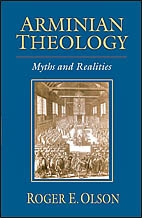
Arminian Theology: A Review

Image


Olson, Roger E. Arminian Theology. Downers Grove: Intervarsity Press. 2006. 250 pgs. $14.07


Introduction

Roger E. Olson is professor of theology at George W. Truett Theological Seminary of Baylor University in Waco, Texas. He received his PhD from Rice University and is a well recognized historical theologian and advocate of Arminianism. Among his various publications include, The Story of Christian Theology: Twenty Centuries of Traditions and Reform, The Mosaic of Christian Belief: Twenty Centuries of Unity and Diversity and The Westminster Handbook to Evangelical Theology.

Summary

The thesis of Arminian Theology: Myth and Realities stays true to its title. Olson’s desire is to inform readers of the misunderstandings of classical Arminian theology and to offer a corrective. (15) It is not the effort of the author necessarily to offer exegetical evidence for the doctrines taught in Arminian theology; however, the goal is to provide information for the sake of clarity. (43)

In order to accomplish the goal of communicating clearly the historical views of classical Arminianism Olson provides a historical survey. First, Olson offers what he understands to be misunderstandings of Arminian theology, the myth. He then surveys Arminian theologians beginning with Arminius to Twentieth Century theologians to offer a corrective, the reality. Each of the myths and realities chosen hopes to show readers that classical Arminianism is an option in the spectrum of evangelicalism. In this regard it is important to note a categorical distinction made by the author. Olson separates classical Arminianism, which he calls Arminianism of the heart, from the Philip Lomborch and the Remonstrance which he calls Arminianism of the head. (55) Furthermore, he will accredit much of the misunderstanding concerning classical Arminianism to this later group.

Olson attempts to plant Arminianism firmly in the spectrum of evangelicalism by arguing that it is not totally opposite of Calvinism. The argument is mainly concerned with the fundamental doctrines of the faith. Olson shows that the two camps both hold to the historical teachings of the ecumenical councils, but does not shy away from mentioning providence and depravity. (58) However, Olson wants to make very clear that Arminianism and Calvinism are distinct and no hybrid should be considered. The major doctrines prevenient grace vs. effectual calling, unconditional vs. conditional election, and monergism vs. synergism show that these two camps must stay distinct. One cannot claim to be both. (68) Furthermore, Olson suggests that there is an important misunderstanding in the foundational difference between the two camps. Rather than the bondage of the will vs. libertarian free will, Olson claims that the difference is whether God is pictured to be all powerful and controlling or loving and merciful. (73)

Among the more serious myths suggested by Olson is that Arminianism is not a grace centered theology.  He defends Arminianism’s belief in total depravity and cites various Arminian theologians to support his cause. (142) Following this Olson defends classical Arminianism by arguing that the system believes no one can be saved outside of God prevenient grace. (160) Olson argues that for Arminius grace was not the issue, but whether not that grace could be resisted. (162) He offers sources such as Arminius, Wesley, Wiley, Miley, and others to prove his point.

Due to the number of myths offered by Olson, ten in all, it is not possible to cover them all adequately. Of main concern are those that would exclude Arminianism from evangelicalism. Among the other doctrines discussed are sovereignty, predestination, justification, and the atonement. Once the general format is understood it is not difficult to have a basic understanding of the book. He provides a myth and then offers the historical corrective by citing sources from Arminian theologians. All of this effort is designed to shed light on the misunderstandings by Calvinist and to prove that Arminianism is an evangelical option.

Critical Evaluation

There is no doubt that Olson is a fine historian. In his effort to defend Arminianism each chapter is filled with source material from Arminius, Simon Episcopus, Philip Lomborch, John Wesley, Richard Watson, John Miley, and many others. One can disagree with the logical conclusions of someone’s belief, but it is difficult to argue with what they actually believe when original sources are cited. This is the strongest argument Olson offers. He shows astute historical eyes and offers a variety of sources that back up his correction to the myth being considered. Furthermore, the clarity Olson brings in separating classical Arminianism form the Philip Lomborch and the Remonstrance is insightful. Olson writes, “Of course, this mistake arises from a misconception of Arminius’s own theology or for mistakenly equating Arminianism with the late Remonstrate Arminianism of the head.” (55)

            Olson should also be commended for affirming Calvinism as an evangelical option. Although he cites many Calvinist authors who have claimed Arminiansim not to be evangelical, he does not overreact in his disagreements to exclude Calvinist brothers from the evangelicalism spectrum.

In recent years many have taken Arminianism to an extreme conclusion known as open theism. Olson is hesitant to adopt this view and for that he should also be commended. He writes, “If open theism is true, election and reprobation can only be corporate. But classical Arminianism bases a great deal on Romans 8:29, which seems to refer not to classes or groups but to individuals.” (198) That Olson finds biblical reasons to reject open theism is a positive. However, it is disappointing to find that Olson finds this position to be an evangelical option. In fact, in a footnote on pg. 198 the word “yet” is telling, “I consider open theism a legitimate evangelical and Arminian option even though I have not yet adopted it a my own perspective.” This compromise is disturbing and is sure to make many skeptical of Arminianism the closer these two views are related.

       When analyzing a book it is important to follow the thesis and purpose to see if the author achieves the goal presented. There is without doubt that he achieves the goal of communicating information in order to correct misunderstandings of Arminianism. However, although Olson claims he does not want to offer exegetical proof he ventures into such discussions once or twice. When he does explore the exegetical side of the argument it is often done poorly and leaves the reader dissatisfied. When speaking of John 6 Olson writes, “Contrary to what some Calvinist commentators argue, the Greek word elko (e.g., John 6:44) does not have to mean “drag” or “compel.” (159) To back up his claim Olson cites an unpublished exegetical paper. This is all the argumentation he gives. This will be frustrating for those who oppose the doctrine of prevenient grace. If, as stated by Olson, his goal is not to offer exegetical argumentation then he should have been hesitant to enter this discussion in the manner he did. Olson also says harsh things concerning the Calvinistic doctrines of sovereignty and providence. (118-124; 136) Olson claims that the Calvinistic understanding paints God into a moral monster. Furthermore, that the Calvinistic automatically makes God guilty of sin and evil. Again, the argumentation and claims made in these pages stray from Olson’s intention to provide information about Arminianism. Entering into the accusation and argumentation game in a book not intended to prove such arguments leaves readers wanting.

Despite the previous criticisms it should be noted that the majority of the work stays true to its intention. Olson provides a historical survey second to none concerning the doctrines of Arminianism. He uses original sources efficiently making it difficult for readers to find the sources cited to be guilty of the “myths” often associated with them. If the reader is wanting a thorough exegetical study of Arminianism this work is not appropriate. If readers want a clear survey of the Arminian position that is brief and readable then this book certainly is appropriate. Readers of all theological traditions should carefully consider what Olson has written. Regardless of whether one agrees with the theological conclusions this book serves as a helpful tool to provide clarity. Why? Because Olson is correct in saying, “Before you disagree make sure you understand.” (41)