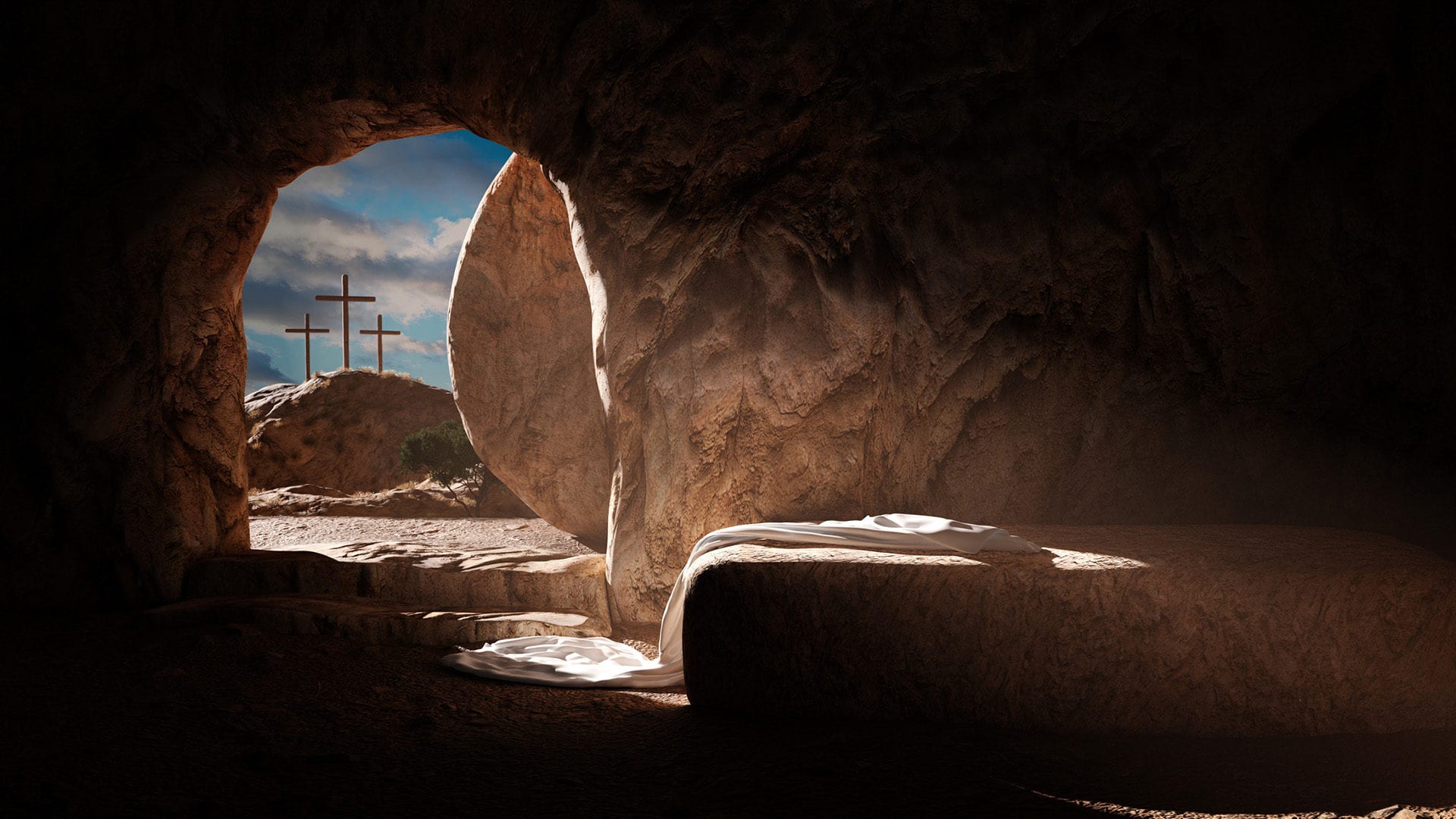
Sermon Idea: The Christian Life is resurrection life, dead to sin and alive to God in Christ Jesus.
Introduction: The Bible contains some powerful conditional phrases. You may not think about conditional phrases much, and that’s ok, but when we allow ourselves to hear them, they can be rather sobering. Let me give you a few examples.
14 And if Christ has not been raised, then our preaching is in vain and your faith is in vain. (1 Co 15:14)
17 And if Christ has not been raised, your faith is futile and you are still in your sins. (1 Co 15:17)
19 If in Christ we have hope in this life only, we are of all people most to be pitied. (1 Co 15:19)
With three powerful conditional phrases, the apostle Paul tells us that our entire Christian faith, ministry, and labors are in vain if Christ is not risen. Those are phrases that pack a punch.
Oh, but if he is, God has made him both Lord and Christ (Acts 2:36). If he is, all who confess with (their) mouth that Jesus is Lord and believe in (their) heart that God raised him from the dead, (they) will be saved. 10 For with the heart one believes and is justified, and with the mouth one confesses and is saved. (Ro 10:9–10)
I suspect we all understand the importance and centrality of Jesus Christ’s resurrection for the Christian faith. Without the resurrection, there is no Christian faith. I suspect we also recognize the importance of the resurrection for salvation—without the resurrection, there is no salvation.
I wonder, though, if we have reflected adequately enough on the importance of the resurrection for the Christian life. What connection is there between Christ’s resurrection from the dead and our life as a Christians? How does the resurrection of Jesus inform how we now live?
Of course, there is a deep, powerful connection between the resurrection and the Christian life because the Christian Life is resurrection life, dead to sin and alive to God in Christ Jesus.
The foundational doctrine that supports this connection and which is so important for understanding nearly everything said in the New Testament about what it means to be a Christian is the doctrine of union with Christ. Every Christian is spiritually and mysteriously united to Jesus Christ by the indwelling of the Holy Spirit and through faith.
One of the best descriptions of this doctrine comes from Paul’s personal testimony in Galatians 2:20, I have been crucified with Christ. It is no longer I who live, but Christ who lives in me. And the life I now live in the flesh I live by faith in the Son of God, who loved me and gave himself for me. (Ga 2:20)
This union with Jesus Christ is how we gain access to the benefits and blessings of salvation.
The Sixteenth-century Protestant Reformer, John Calvin, was right when he wrote, “We must understand that as long as Christ remains outside of us, and we are separated from him, all that he suffered and died for the salvation of the human race remains useless and of no value for us…All that he possesses is nothing to us until we grow into one body with him.”
In Romans 6, Paul develops the practical implications of union with Christ for the Christian life. He begins by highlighting our union with the death of Christ in Romans 6:1-4.
What shall we say then? Are we to continue in sin that grace may abound? 2 By no means! How can we who died to sin still live in it? 3 Do you not know that all of us who have been baptized into Christ Jesus were baptized into his death? 4 We were buried therefore with him by baptism into death, in order that, just as Christ was raised from the dead by the glory of the Father, we too might walk in newness of life. (Ro 6:1–4)
Paul is answering forcefully any and all who would suggest that the grace of God in salvation is a license to sin. He says in the most emphatic terms, “By no means!”
The reason why we are not to use God’s grace as a license to keep sinning is that through faith, every Christian has been united to Jesus in his death. How can we who died to sin still live in it? (Rom. 6:2)
We are not to live in sin, but because of our union with Christ, we are to “walk in newness of life.” (Rom. 6:4)
So far, though, Paul has only connected the believer with Christ’s death. How can we walk in newness of life?
This morning’s text supports the main idea Paul wants to communicate in verse 4: Christians are to walk in the newness of life. Union with Christ is not only with his death but also with his resurrection. The Christian life is resurrection life, dead to sin, and alive to God in Christ Jesus.
My hope this morning is that you’ll be reminded of the great grace and power at work within us. We’ll be stirred to walk in the newness of life all the more because of our blessed union with Christ.
I.) The Christian life is dead to sin (Romans 6:5-7)
Since we are united with Christ’s death, we will be united with his resurrection.
5 For if we have been united with him in a death like his, we shall certainly be united with him in a resurrection like his. 6 We know that our old self was crucified with him in order that the body of sin might be brought to nothing, so that we would no longer be enslaved to sin. 7 For one who has died has been set free from sin (Ro 6:5–7)
Paul says we will be raised one day, just as Christ was raised from the dead. That future assurance is not only the essence of Christian hope but also the fuel for the Christian life in the present. Those who will be physically raised in the future are spiritually raised now through faith in Christ.
4 But God, being rich in mercy, because of the great love with which he loved us, 5 even when we were dead in our trespasses, made us alive together with Christ—by grace you have been saved— 6 and raised us up with him (Eph 2:4–6)
The result of dying and being raised with Christ is that he old self that was in bondage to and guilty of sin has been crucified. This means that the Christian life is dead to sin! What does it mean to be dead to sin?
Paul explains that being dead to sin means being set free from slavery.
When Chris Tomlin wrote his version of the classic hymn Amazing Grace, he added a chorus.
My chains are gone, I’ve been set free
My God, my Savior has ransomed me
And like a flood His mercy reigns
Unending love, amazing grace
The Christian life is dead to sin, so it is free of sin’s penalty and power.
The Bible makes it clear that the penalty for sin is separation from God and, ultimately, death. When Adam and Eve fell, they were expelled from the garden. Sin disrupted and fractured their free access to God’s presence. Although they did not die physically right away, they suffered the spiritual death that sin brings. The penalty for sin is death.
23 For the wages of sin is death, but the free gift of God is eternal life in Christ Jesus our Lord. (Ro 6:23)
The gospel’s good news is that those who are in union with Christ are dead to sin and so free from sin’s penalty. We now experience the presence of God through our mediator, Jesus Christ, and although we will all still taste physical death, we have the hope of resurrection.
Before Jesus rose Lazarus from the dead, he told Martha, I am the resurrection and the life. Whoever believes in me, though he die, yet shall he live, 26 and everyone who lives and believes in me shall never die. (Jn 11:25–26)
This resurrection Sunday, we must believe that union with Christ means being dead to sin and being free from sin’s penalty. We need to let the amazing freedom of the gospel lead us to greater obedience out of gratitude.
Not only are we free from sin’s penalty, but we are also free from sin’s power. That is the primary focus of Paul’s encouragement with the words, “…so that we would no longer be enslaved to sin. 7 For one who has died has been set free from sin.”
Being dead to sin means that sin can no longer master the Christian. We have been released from its realm, no longer in its bondage, and freed from its power.
This is why Paul can say in verse 12, “Let not sin therefore reign in your mortal body to make you obey its passions,” and in verse 14, “For sin will have no dominion over you, since you are not under law but under grace.
At this point, we need to note something very important. Although we are currently free from sin’s penalty and its power, we are not yet free from its presence. Sin and its influence will remain with us until that final day when God makes all things new.
We are free from sin’s penalty and power, not from its temptations, nor from the spiritual enemies that wish us harm.
14 But each person is tempted when he is lured and enticed by his own desire. 15 Then desire when it has conceived gives birth to sin, and sin when it is fully grown brings forth death (Jas 1:14–15)
8 Be sober-minded; be watchful. Your adversary the devil prowls around like a roaring lion, seeking someone to devour. (1 Pe 5:8)
What’s the point? The Christian life is dead to sin’s power, and so must continually put sin to death as long as it remains present in our lives. We are redeemed but not yet glorified, so we live the Christian life by striving to become more of what God has already declared us to be.
What the Bible calls us to is what many in the Christian tradition have called mortification. We are to mortify our sin by putting it to death. By grace and in the power of the Spirit, we are to deny temptation, discipline our spiritual lives, and kill any and all sin that remains with us.
5 Put to death therefore what is earthly in you: sexual immorality, impurity, passion, evil desire, and covetousness, which is idolatry. 6 On account of these the wrath of God is coming (Col 3:5–6)
13 For if you live according to the flesh you will die, but if by the Spirit you put to death the deeds of the body, you will live (Ro 8:13)
Passages like these led the Puritan John Owen to say, “…be killing sin or it will be killing you.”
We do not kill sin to become dead to sin and right with God. We continue to kill sin because we are right with God, united to Christ, and the power of sin no longer has mastery over us.
Given the gravity of these commands, it is good for us to reflect on whether we are actively putting sin to death in our own Christian lives and what it may look like if we are not.
The Christian who is putting sin to death is aware of their vulnerability and seeks to limit opportunities for temptation.
When I was in college, I was required to read Homer’s The Odyssey for a Great Books Seminar. It is a long epic poem about a character named Odysseus. At one point in the journey, Odysseus learns of the Island of Sirens, which he must pass by. The island was filled with siren singers who would sing a beautiful song, certain to lure men to their death.
In her classic book on Greek Mythology, Edith Hamilton describes the sirens this way: “These were marvelous singers whose voices would make a man forget all else, and at last their song would steal his life away. Moldering skeletons of those they had lured to their death lay banked high up around them where they sat singing on the shore.”
Odysseus is a perfect example of what not to do in the face of temptation and sin. He commands everyone except for himself on board his ship to fill their ears with wax. He wants to hear the song, so he ties himself to the boat and commands his comrades not to let him get away, no matter how much he attempts to do so.
Christians who put sin to death don’t act like Odysseus. They grow in their self-awareness and attempt to avoid temptation. When they become aware of sin in their life, they quickly confess, repent, and pray for the grace to change. There is a growing hatred for sin in their lives and a growing desire for holiness in its place.
What might a life look like that is not killing sin? I want to offer you four quick descriptions of someone who may not be killing sin.
1. You may not be killing sin if you’re growing more defensive about your habits and life patterns.
2. You may not be killing sin if you often deflect conversations from spiritual things.
3. You may not be killing sin if you’re easily distracted and unable to tend to your own spiritual life.
4. You may not be killing sin if you’re growing distant from your local church and its gatherings.
How is your walk with the Lord this morning? Which description is most apt for how you seek to follow Jesus day by day?
Friends, the Christian life is dead to sin. Let us not coddle sin, manage sin, or entertain sin. Let us crucify it by grace and in the power of the Spirit.
II.) The Christian life is alive to God in Christ Jesus (Romans 6:8-11)
8 Now if we have died with Christ, we believe that we will also live with him. 9 We know that Christ, being raised from the dead, will never die again; death no longer has dominion over him. 10 For the death he died he died to sin, once for all, but the life he lives he lives to God. 11 So you also must consider yourselves dead to sin and alive to God in Christ Jesus. (Ro 6:8–11)
There is a deep, powerful connection between the resurrection and the Christian life because the Christian Life is resurrection life, dead to sin and alive to God in Christ Jesus.
Our shared union with Christ doesn’t simply crucify the old self that was in bondage to sin, but gives us a new life in the power of Christ’s resurrection. This has great implications for our Christian faith as well. Just as we are commanded to kill sin because of our union with Christ’s death, we are called to walk in the newness of life because of our union with Christ’s resurrection. This has often been called vivification.
We need to kill vices and cultivate virtues. The Christian life consists of dying to sin and living unto righteousness.
In other words, we don’t just want to kill greed. We want to grow in generosity.
We don’t just want to kill bitterness. We want to grow in mercy and forgiveness.
We don’t just want to kill lust. We want to grow in love and purity.
This is why, after Paul tells us to put off the old man, we are to put on the new.
12 Put on then, as God’s chosen ones, holy and beloved, compassionate hearts, kindness, humility, meekness, and patience, 13 bearing with one another and, if one has a complaint against another, forgiving each other; as the Lord has forgiven you, so you also must forgive. 14 And above all these, put on love, which binds everything together in perfect harmony. (Col 3:12–14)
How does vivification happen in the life of the Christian? How are we continually renewed to walk in the newness of life after killing sin?
As you might expect, the answer is rather ordinary and involves God’s means of birthing and strengthening our faith. There is no secret to renewed life in Christ, no acceleration program, and no guru who can lifehack your sanctification.
There is the Word of God and the promise of God’s Spirit to work through the ordinary means of grace corporately and privately for our good and his glory.
Those who are being vivified by God’s Spirit are immersed in the Word of God, devoted to prayer, and prioritize Christian fellowship and friendship.
Beloved, you are united with Christ, and the power of his resurrection is at work in you. We can and should walk in the newness of life.
The Christian Life is resurrection life, so let us die to sin and live unto God in Christ Jesus.

 Nathaniel R. Martin